
Traditional characters 8
Learning Chinese: writing the traditional characters of Unit 8
Please choose how the character breakdown is displayed:
愛 : to love, love.
Stroke order:
Components: 爫 claw, grasping hand (top); 冖 lid; 心 heart; 夊 foot walking slowly (bottom).
Etymology: 愛 represents a hand 爫 that reaches to grasp a heart 心 protected under a lid 冖, the whole carried by hesitant steps 夊 moving toward the other person. The original idea is that of a precious feeling one protects and offers while walking toward the loved one. The simplified form 爱 replaced 心 + 夊 with 友 (friend), hence the popular pun: "simplified love is love without a heart."
Character evolution:
| Bronze | Seal script | Clerical script | Regular script | Simplified |
|---|---|---|---|---|
| 爱 | 爱 | 爱 | 爱 | 爱 |
歡 : joy, gladness (in 喜歡 "to like, to enjoy").
Stroke order:
Components: 雚 heron, stork (left, phonetic element); 欠 wide-open mouth (right).
Etymology: 歡 is a phono-semantic compound. 雚 (heron) provides the pronunciation, and 欠 represents a person whose mouth is wide open. The character evokes the vocal expression of joy: shouting, laughing with happiness. By extension, 歡 means "joyful, happy." Combined with 喜 , it forms 喜歡 "to like, to enjoy."
Character evolution:
| Bronze | Seal script | Clerical script | Regular script | Simplified |
|---|---|---|---|---|
| 欢 | 欢 | 欢 | 欢 | 欢 |
貓 : cat.
Stroke order:
Components: 豸 radical of the long-bodied wild animal, used for felines (left); 苗 sprout, young plant (right, phonetic element).
Etymology: 貓 is a phono-semantic compound. The radical 豸 indicates a long-bodied animal (used for felines, panthers, etc.), and 苗 provides the pronunciation while evoking the cat's meow. In the simplified form 猫, the radical 豸 was replaced by 犭 (variant of 犬 "dog").
Character evolution:
| Bronze | Seal script | Clerical script | Regular script | Simplified |
|---|---|---|---|---|
| 猫 | 猫 | 猫 | 貓 | 猫 |
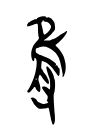
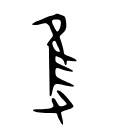
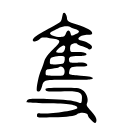
隻 : classifier for small animals (cats, dogs, birds…); : only.
Stroke order:
Components: 隹 short-tailed bird (top); 又 right hand (bottom).
Etymology: 隻 is an ideogram representing a hand 又 holding a bird 隹 that has been caught. Originally, it referred to the act of catching a single bird (as opposed to 雙 "two birds," which shows two 隹). By extension, 隻 became the classifier for animals counted individually (a cat, a dog, a bird…). The derived meaning "only" is written in simplified form as 只.
Character evolution:
| Oracle bone | Bronze | Seal script | Regular script | Simplified |
|---|---|---|---|---|
 |
 |
 |
隻 | 只 |
點 : dot, a little; o'clock (一點 = one o'clock).
Stroke order:
Components: 黑 black (left); 占 to occupy (right, phonetic element).
Etymology: 點 is a phono-semantic compound. The radical 黑 (black) indicates the original meaning: a small black mark, a dot. 占 provides the pronunciation. By extension, 點 refers to the dot, the mark, but also "a little" and the full hour: 一點 "one o'clock."
Character evolution:
| Bronze | Seal script | Clerical script | Regular script | Simplified |
|---|---|---|---|---|
| 点 | 点 | 点 | 点 | 点 |